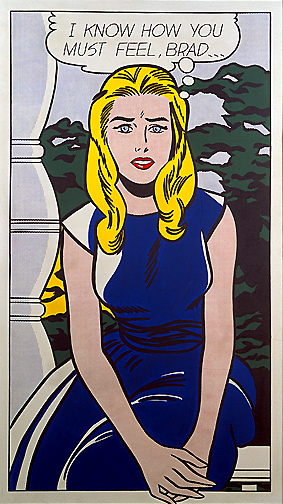
terça-feira, 16 de abril de 2013

Die Zukunft gehört der Tautologie von Boris Groys

Die modernen Methoden der Erzeugung, Speicherung, Vervielfältigung und Übertragung von Texten und Bildern haben uns die Fähigkeit verlie­hen, mit immer größerer Geschwindigkeit immer mehr »Kultur« und »Kunst« zu produzieren. Dieser Texte- und Bilderüberfluß muß irgend­wie begrenzt werden, damit wir im von uns produzierten textuellen und visuellen Müll nicht untergehen. So stellt sich die Frage nach den Krite­rien, die es uns erlauben würden, gewisse Texte und Bilder auszusortie­ren und aufzubewahren - und die anderen zu entsorgen. Wir brauchen eine Zensur, um die kulturelle Produktion zu begrenzen und die Welt nicht in eine einzige Kulturmüllhalde zu verwandeln. Jede Zivilisation verfügt über eine solche ökologisch motivierte Zensur, die nur in einigen Fällen zugleich als ideologische oder politische Zensur funktioniert. Eine solche politisch-ideologische Zensur erweist sich übrigens oft als nicht genügend effektiv, weil nicht genügend radikal. So hat der vor kurzem verblichene sowjetische Sozialismus, trotz einer strengen politischen Zensur, Unmengen von Texten und Bildern produziert. Das zeigt, wie leicht es ist, sich einer solchen Zensur anzupassen, und wie ineffektiv sie ist, wenn es sich um eine konsequente Begrenzung des kulturellen Mülls handelt.


Früher operierte die entsprechende kulturökologische Zensur mei­stens - und sehr effektiv - mit dem Begriff »Qualität«. Kunstwerke, literarische oder philosophische Texte und sonstige kulturelle Artefakte wurden nach ihrer »Qualität« beurteilt und ausgewählt. Die Werke, die diese geheimnisvolle »Qualität« besaßen, wurden sorgfältig aufbewahrt, ihre qualitätslosen Kollegen hingegen mitleidlos weggeworfen. Die Qua­lität eines neuen Kulturprodukts ergab sich durch den Vergleich mit einem im voraus festgelegten Kanon der Meisterwerke. Falls ein gewisses »Niveau«, das diese Meisterwerke angeblich auszeichnete, vom neuen Werk erreicht wurde, durfte dieses neue Werk in die große Tradition aufgenommen werden. Wie dieses Niveau zu ermitteln ist, blieb absicht­lich unklar, weil die explizite Angabe der Kriterien der Zensur die
Anpassung an sie wesentlich erleichtern und die kulturelle Produktion zu sehr ankurbeln würde. Für Wissenschaft und Philosophie war Qualität als »Wahrheit« definiert, für die Kunst als »Schönheit«.


Damit Wahrheit und Schönheit erreicht werden können, müssen aber gewisse Regeln, nach denen man sie produziert, ihrerseits reproduziert werden. In den früheren, vormodernen Zeiten war die Reproduktion dieser Regeln schwierig und verlangte viel Anstrengungen seitens des Künstlers und Wissenschaftlers. In der Moderne, die die neuen techni­schen, vom einzelnen Menschen unabhängigen Reproduktionsverfahren entwickelt hat, wurde die kulturelle Reproduktion und damit auch das Erreichen der ersehnten »Qualität« wesentlich erleichtert. Die begren­zende Wirkung der Zensur, die mit dieser Qualität operierte, wurde dadurch drastisch vermindert, und die kulturelle Überproduktion nahm ein bedrohliches Ausmaß an.


Im Laufe der Moderne wuchs die Zahl der »qualitätsvollen« Kulturprodukte ins Unermeßliche. Zu viele Künstler haben gelernt, gut zu malen. Zu viele Schriftsteller haben gelernt, gut zu schreiben. Und zu viele Philosophen und Gelehrte haben angefangen, nach allen Regeln ihrer Kunst zu viel Wahrheit zu produzieren. So konnte die Qualitätszensur keinen richtigen Schutz mehr gegen den Überfluß der kulturellen Artefakte bieten.


Daraus entstand die Notwendigkeit einer Neubegründung der kultu­rellen Zensur. Der neue Begriff, der mit diesem Ziel eingeführt wurde und auch in unserer Zeit die herrschende Zensur immer noch legitimiert, heißt »Innovation«. Es wäre ein großes Mißverständnis zu glauben, daß die Valorisierung des Neuen in der Moderne eine kulturelle Dynamik, eine Entfaltung der kreativen Freiheit oder eine Beschleunigung der kul­turellen Produktion begünstigte. Ganz im Gegenteil dient der Begriff des Neuen in der Moderne allein der Verlangsamung und Unterdrückung der durch die neue Technik beschleunigten Text- und Bildproduktion. Der Begriff des Neuen hat in der Moderne die ökologische Zensurfunktion übernommen, die früher der Begriff der Qualität erfüllte. Wenn man früher sagen durfte: »Weg damit, denn es ist nicht qualitätsvoll genug«, so darf man heute sagen: »Weg damit, denn es ist nicht innovativ genug.« Die Ablehnung eines Werks, sei es eines Kunstwerks, sei es einer wissen­schaftlichen Theorie, wird heute in der Regel damit begründet, daß das betreffende Produkt nicht neu, nicht innovativ, nicht kreativ ist. »So etwas haben wir schon einmal gesehen, oder gehört, oder gelesen«, hört man immer wieder, wenn eine negative Beurteilung erfolgt.


Dabei bleibt der Begriff »Innovation« im Grunde genauso vage, wie es früher der Begriff »Qualität« war. Wenn aber »Qualität« zu besitzen ungefähr das gleiche bedeutet, wie an die traditionellen Vorbilder zu er­innern, bedeutet »innovativ« oder »kreativ« zu sein, etwas zu produzieren, was sich von diesen Vorbildern unterscheidet. Nun hängen aber sowohl Ähnlichkeiten als auch Unterschiede im wesentlichen davon ab, unter welchem Gesichtspunkt man das Neue mit dem Alten vergleicht. Was in einer Hinsicht sich als ähnlich darstellt, erweist sich in einer an­deren Hinsicht als völlig anders. So kreisen alle Legitimierungsdiskurse in unserer Zeit um die Frage, wie man das Neue mit dem Alten verglei­chen soll und darf.


Die Meinungen sind immer gespalten. Während die einen beispielsweise glauben, daß die ganze postmoderne Kunst von der amerikanischen Pop-art bis heute eine regressive, nicht-innovative, anti­moderne Haltung verkörpert, weil sie die Dinge der Außenwelt abbildet, von denen uns die abstrakte Kunst schon einmal befreit hat, glauben die anderen, daß die abstrakte Kunst den gesellschaftlichen Status des Kunst­werks nicht radikal genug in Frage gestellt hat und daß die postmoderne Kunst, die gerade dies tut, deswegen viel innovativer ist, als die abstrakte Kunst es war. Der Vergleich vollzieht sich in diesem Fall offenbar auf zwei unterschiedlichen Ebenen, was den Begriff Innovation unscharf macht. Und trotzdem wird die Zensurfunktion des Begriffs Innovation dadurch nicht ernsthaft in Frage gestellt, denn sobald mit einer gewissen Plausibilität nachgewiesen werden kann, daß ein bestimmtes Werk in kei­ner relevanten Hinsicht innovativ ist, wird dieses Werk dem Müll gleich­gesetzt und kulturell entsorgt.


Und damit wird das meiste, was in der Moderne produziert wird, automatisch zum Müll. Die moderne Zivilisation zeichnet sich nämlich, wie gesagt, vor allem durch ihre Fähigkeit zur genauen Reproduktion des Bestehenden aus. Uber die technische Reproduktion der Texte und der Bilder wurde zumindest seit Benjamin genug geschrieben, aber eine viel­leicht noch viel wichtigere Institution der kulturellen Reproduktion ist die allgemeine Schulbildung, die allen Kindern das gleiche Wissen ver­mittelt. Die modernen Medien reproduzieren massenweise bestimmte Formen der Alltagskultur und der Unterhaltung, internationale Hotel- und Restaurantketten servieren das gleiche Essen, und die psychologi­sche Beratung in ihren verschiedenen Varianten reproduziert genauso massenweise bestimmte Muster des inneren Lebens. Uber die Unifizie­rung der Arbeitsvorgänge in der Moderne wurde ohnehin genug gespro­chen und geschrieben. Die moderne Zivilisation produziert in erster Linie Identitäten: gleiche Autos, gleich aussehende Menschen, die gleich denken usw. Es ist offensichtlich, daß vor diesem Hintergrund die For­derung nach dem Neuen, nach der Innovation, nach der Kreativität vor allem eine repressive Funktion hat, denn die meisten Kulturprodukte und die meisten Menschen werden durch diese Forderung kulturell dis­qualifiziert und als irrelevant abgestempelt. Die Forderung nach dem Neuen ist die neue Legitimation für die Elitebildung geworden, nachdem die traditionellen Kriterien des Wahren, Schönen und Guten sich als nicht mehr funktionsfähig erwiesen hatten, da das Wahre, Schöne und Gute durch ihre Über(re)produktion abgewertet worden waren.


Die gesellschaftliche Valorisierung der Innovation in der Moderne wurde oft als Ausdruck menschlicher Freiheit mißverstanden, weil sie irrtümlicherweise als Lizenz, das Neue zu tun, interpretiert wurde. Aber die Valorisierung des Neuen ist in Wahrheit ein Verbot, das Alte zu tun. Ausdruck der genuinen menschlichen Freiheit wäre die Möglichkeit, so­wohl das Alte als auch das Neue zu tun. Diese Möglichkeit gibt es in der Moderne nicht. Statt dessen wird der moderne Mensch ständig mit man­nigfaltigen und vielschichtigen Verboten konfrontiert, die durch die Ideologie der Innovation begründet sind. Erstens ist verboten, alles das zu tun, was früher war. Zweitens verbietet die Innovation sich selbst, denn sobald etwas schon gedacht oder gemacht ist, ist es nicht mehr neu und darf deswegen auch nicht wiederholt werden.


So ist der Kreator dazu verurteilt, zu sich selbst ständig Distanz zu nehmen und sich selbst zu widersprechen: er darf auch sich selbst nicht reproduzieren. Vor allem die künstlerische Avantgarde dieses Jahrhunderts, die das Prinzip des Neuen am radikalsten verkörpert, wird durch den Satz regiert: So geht es nicht mehr, so darf man es nicht mehr machen. Jede neue Innovation öffnet unter diesen Bedingungen kein neues fruchtbares Land, sondern hinter­läßt eine neue Wüste, denn sie verbietet, wie gesagt, alles Dagewesene, inklusive ihrer selbst. Der Künstler der Avantgarde ist demgemäß kein Erkunder neuer Kontinente, sondern jemand, der ständig in die Wüste geschickt wird und dort zu überleben versucht.

Verbot und Repression bestimmen auch die innere Beschaffenheit des modernen Werks: Die Hauptverfahren der modernen Kunst sind Reduk­tion, Verzicht, Askese. Es wurde schon oft bemerkt, daß alle Elemente der modernen Kunst auch in den früheren Epochen zu finden sind: ab­strakte Malerei, Lautpoesie usw. können als Standard-Komponente der traditionellen Kunstwerke identifiziert werden. Was ist dann an diesen Formen neu? Die Antwort lautet: Neu ist allein die Reduktion des Werks auf diese bestimmten Komponenten, neu ist das Verbot, andere Kompo­nenten zu benutzen, neu ist die Askese, die das moderne Kunstwerk bestimmt, neu ist das Verhängnis, immer nur Quadrate zu malen oder sinnlose Laute von sich zu geben. Auch die Postmoderne hat an diesem Verhängnis nichts geändert, denn sie zwingt den Künstler dazu, fremde Bilder abzumalen oder fremde Texte zu zitieren - und auf das Eigene zu verzichten. Der moderne Künstler ist wie ein frühchristlicher Asket oder wie ein indischer Yogi, der immer weiter in die Wüste gedrängt wird und seinen Körper in immer unnatürlichere, innovativere, unerträglichere Po­sen zwingt.

In letzter Zeit regt sich freilich zunehmend eine demokratisch moti­vierte Revolte gegen die Elitebildung durch das Neue. Auf viele unter­schiedliche Weisen wird das Neue dabei theoretisch und praktisch unterminiert. Man verkündet seine Freude am Kitsch und an der Massen­kultur. Man huldigt der Trivialität und der Popkultur. Und vor allem: Man stellt den universalen geschichtlichen Kontext in Frage, in dem das Neue ermittelt wird. Und in der Tat: wenn wir über keinen allgemeinen kulturellen Kontext und über keine Vision der universalen Geschichte verfügen, können wir nicht mehr sagen, was neu ist und was nicht. Der Begriff Innovation zerfällt damit, so daß für einen partiellen Kontext und im Verlauf einer partiellen Geschichte etwas als neu anerkannt werden kann, das für andere partielle Kontexte und Geschichten keineswegs neu ist. Unter diesen Voraussetzungen der radikalen Pluralität kann buch­stäblich alles als neu gelten, denn immer findet sich jemand, der von bestimmten Dingen immer noch nichts gehört hat, von denen alle ande­ren schon nichts mehr hören können.


Nun waren solche Unterminierungsversuche aber bis jetzt nur bedingt erfolgreich, denn der Ort für die Entstehung und Ermittlung des Neuen sind nicht personelle Geschichten, sondern kulturelle Archive, wie Mu­seen, Bibliotheken, Filmarchive usw. Mit Hilfe dieser Archive kann festgestellt werden, ob etwas neu ist oder nicht, unabhängig davon, ob es jemandem als neu erscheint. Mehr noch: die Diskurse, die das Neue kontextualisieren, partikularisieren und damit unterminieren wollen, sind für die kulturellen Archive nur deswegen interessant, weil diese Dis­kurse selbst neu sind. Die postmoderne, populistische Kritik an dem Begriff des Neuen kann also in einer Kultur, die sich archiviert, eine Aufweichung der Zensur des Neuen, aber keine Abschaffung dieser Zen­sur erreichen, denn diese Kritik selbst kann sich nur durch den gleichen Begriff des Neuen legitimieren.


In der Moderne spielt das Archiv in bezug auf das Neue die gleiche Rolle, die der traditionelle Kanon in der Vormoderne in bezug auf die Qualität gespielt hat. Der Kanon war die Sammlung der relativ homoge­nen Vorbilder, mit denen das neue Werk verglichen werden konnte, um Ähnlichkeiten festzustellen. Das Archiv ist eine Sammlung von heteroge­nen Innovationen, von Abweichungen und Andersartigkeiten, die zu ermessen erlaubt, inwieweit ein neues Werk innovativ ist, d. h. inwieweit dieses Werk seinerseits eine Abweichung von alledem darstellt, was im Archiv schon gesammelt ist. Der Kanon produziert Identität, das Archiv produziert Differenz. Solange das Archiv existiert, wird die Innovation sowohl möglich als auch notwendig sein. Die Frage stellt sich aber: wie lange?


Mit der Zeit wird eine tiefe Krise der Archive immer offensichtlicher.
Das Neue wird seinerseits immer schneller und in größeren Massen pro­duziert, wie es früher mit dem Identischen der Fall war, weil die Menschen immer besser verstehen, was es heißt, innovativ zu sein. Zu­dem erlaubt es die heutige Technik, nicht nur Originale identisch zu reproduzieren, sondern einprogrammierte Abweichungen von diesen Originalen zu generieren. Ebenso wie die Identitäten können jetzt auch die Differenzen technisch, seriell produziert werden. Zusätzlich werden durch geschickte Uminterpretierung immer neue kulturelle Artefakte, die früher als »identisch« galten, als andersartig (wieder)entdeckt. Da­durch werden die Archive überfüllt, wie es früher die Sammlungen der als kanonisch geltenden Werke waren. Wohin auch immer man heutzu­tage blickt, sieht man Differenz. So werden die Begriffe des Neuen und des Anderen allmählich immer weniger tauglich, die kulturelle Überpro­duktion einzudämmen. Die Innovationszensur droht genauso ineffektiv zu werden wie die Qualitätszensur von einst. So stellt sich schon heute die Frage: Was kommt danach? Wie wird sich die Kultur vor ihrem eige­nen Müll schützen können, wenn weder Identität noch Differenz diesen Schutz bieten werden?
In der Tat würde die Abschaffung der Innovationszensur mit höchster Wahrscheinlichkeit die Abschaffung jeder Zensur bedeuten, denn uns stehen keine weiteren legitimierenden Begriffe zur Verfügung jenseits von Identität und Differenz. So müssen wir mit der Möglichkeit rechnen, daß die kulturellen Institutionen, die den staatlichen oder gesellschaft­lichen Auftrag haben, darüber zu entscheiden, was gut und was schlecht ist, endgültig ihre Legitimation verlieren. Unter diesen Umständen, wenn es keine Kriterien und keine unabhängige Instanz mehr geben wird, um den kulturellen Wert eines Werks zu bestimmen, wird es zu einer direkten Konkurrenz unter den unterschiedlichen kulturellen An­sätzen und Werken kommen, wie sie schon jetzt im Bereich der Massen­kultur stattfindet. Dabei zeichne* sich bereits deutlich ab, welches Prinzip dieser Konkurrenz zugrunde liegt. Es ist das Prinzip Tautolo­gie.


Wenn sowohl die kanonischen als auch die archivarischen Sammlun­gen der kulturellen Werke keine normative Kraft mehr besitzen und die Institutionen, die diese Sammlungen tragen, keine effektive Zensur mehr ausüben können, werden Texte und Bilder für ihre Rezipienten schwer verständlich, denn das Verstehen kann nur durch den Vergleich mit dem Bestehenden erfolgen. Ein solcher Vergleich ist aber im Meer der unzen­sierten Kulturproduktion nicht mehr möglich. Der einzige Ort eines Vergleichs wird, wenn Archive ihre Normativität einbüßen, die Seele des einzelnen Rezipienten. Aber niemand weiß, was in der Seele des Anderen vor sich geht, wenn eine für alle in gleicher Weise bekannte und verbind­liche Tradition fehlt. Das gilt sowohl für den Produzenten als auch für die Rezipienten der Kultur. Nehmen wir beispielsweise an, wir sehen zum erstenmal das »Schwarze Quadrat« von Malewitsch. Wir können dieses Werk für eine Revolution in der Malerei halten, wenn wir es mit den allgemein bekannten Werken im Archiv der Malerei vergleichen. Aber wenn dieser Vergleich fehlt, können wir vermuten, daß alle Russen im­mer schon schwarze Quadrate gemalt haben (z. B. als Teil einer rituellen Handlung) und daß das »Schwarze Quadrat« von Malewitsch dement­sprechend keine künstlerische Revolution bedeuten kann.


Die Einschätzung der kulturellen Kompetenz des Produzenten wie des Rezipienten wird damit entscheidend für das Verständnis des Werks. Aber man weiß heutzutage kaum mehr, was die anderen Leute lesen, sehen oder denken. Diese neue Befindlichkeit äußert sich im Alltag bei­spielsweise durch das zunehmende Absterben des Humors als einer primären Form der kulturellen Kreativität. Da keiner mehr weiß, was der andere weiß, ist Humor unmöglich geworden: Wenn man eine Bemer­kung hört, hat man keine Mittel mehr, um festzustellen, ob diese Bemerkung ironisch gemeint war oder nicht, denn in unserer pluralisti­schen Gesellschaft können wir keine Meinung von vornherein als »un­seriös« einstufen. So zieht man es vor, auch bei einer offensichtlich widersinnigen Bemerkung ernst zu bleiben, um den Sprechenden nicht zu beleidigen, falls er sie ernst gemeint haben sollte. Erst wenn der Spre­chende versichert, daß seine Bemerkung ironisch gemeint war, zwingt man sich zum Lachen - jetzt um den Sprechenden nicht durch die ernste Miene zum zweiten Mal zu beleidigen.

Dieses kleine Beispiel zeigt in nuce, mit welchen Problemen der heu­tige Kulturproduzent konfrontiert wird. Erstens muß er erraten können, was die Menschen, an die er sich wendet, schon wissen. Zweitens muß er das, was er ermittelt hat, explizit wiederholen, damit sein Publikum weiß, daß auch er weiß, was dieses Publikum weiß. Dabei sind alle Formen der Ironie, Sinn- und Formverschiebung oder des Spiels, d. h. alle Formen der Differenz, ausgeschlossen, denn falls sie auftreten, wird das Publi­kum sie als bewußte, absichtliche Strategie nicht einschätzen können, sondern nur denken, daß der Produzent dank seiner Natur oder seinem kulturellen Background immer schon »anders« ist. Das Neue oder das Differente ist unter diesen Bedingungen nicht mehr möglich. Dagegen muß das Identische immer neu ermittelt werden, weil es nicht mehr im vorhinein festgelegt ist, wie es in den traditionellen oder totalitären Ge­sellschaften der Fall war. Die Identität, die Banalität, die Tautologie werden in einer pluralistischen Gesellschaft zum Problem. Und die Su­che nach der perfekten Tautologie beherrscht zunehmend die heutige Massenkultur.


Vor allem in der amerikanischen Massenkultur macht sich die Suche nach der perfekten Tautologie bemerkbar, weil die USA kulturell beson­ders heterogen sind. Die Herstellung der Tautologie ist dabei nicht nur das Hauptverfahren, sondern auch das große Thema der amerikanischen Massenkultur. Amerikanische Filme oder Fernsehserien bieten immer wieder ein extrem heterogenes kulturelles Bild: Ihre Protagonisten ent­stammen nicht nur unterschiedlichen Rassen, sozialen Schichten und historischen Zeiten, sondern sind oft auch Monster, Außerirdische, Ge­spenster, diverse Tiere, phantastische Gestalten und verrückt gewordene Computer, Autos oder Kühlschränke.


Im Laufe des Films oder der Fern- sehserie müssen alle diese sehr heterogenen Helden aber feststellen, daß sie im Endeffekt gleiche Vorstellungen und gleiche Wünsche haben (bei­spielsweise Familie, gesellschaftliche Anerkennung, der eigene Platz im Leben usw.). Die Suche nach dieser Tautologie bestimmt die Handlung: Sie dient vornehmlich dazu, die Helden in eine extreme Situation zu bringen, die sie dazu zwingt, ihre innersten Wünsche und Gedanken zu explizieren, sie mit den Wünschen und Gedanken der anderen zu verglei­chen und eventuelle Unterschiede und Mißverständnisse zu eliminieren. Die Handlung endet nicht, bevor alle Beteiligten erkennen und explizit formulieren, daß sie das gleiche denken und fühlen wie alle anderen auch. Die Erreichung der perfekten Tautologie spielt hier also die gleiche zen­trale Rolle wie die Katharsis in der aristotelischen Ästhetik.


Allerdings bleibt die einmal erreichte Tautologie nicht lange bestehen und muß, ebenso wie die klassische Katharsis, immer neu inszeniert werden. Die­jenigen Film- oder Fernsehhelden, die an dieser Tautologie nicht teilha­ben, werden übrigens im Laufe der jeweiligen Handlung eliminiert, aber ihr Tod bedeutet keineswegs, daß sie prinzipiell nicht an dieser Tautolo­gie teilhaben können. So gewinnt Terminator i die nötige Einsicht erst in der zweiten Folge des Films, und man kann sich gut vorstellen, daß auch Terminator 2 in der dritten Folge wieder die gleiche Einsicht gewinnen mag.

Unter den Bedingungen der radikalen kulturellen Vielfalt, der herr­schenden Andersartigkeit und der massenhaft produzierten Innovation wird also die Erlangung der Tautologie zum Hauptkriterium für eine kulturelle Leistung, wobei diese Tautologie, wie gesagt, durch keine tra­ditionelle kulturelle Identität garantiert ist und deswegen jedesmal erneut und ad hoc ermittelt werden muß. Es ist offensichtlich, daß der Inhalt der ermittelten Tautologie nach Null, zum Nichts, tendieren muß, da die wachsende kulturelle Vielfalt immer weniger Überschneidungen zuläßt. Die Massenkultur ist also tendenziell nihilistisch, weil sie in der Suche nach der alles umfassenden Tautologie jeden konkreten Inhalt oder jede konkrete Bedeutung negieren muß. Aber Bilder und Zeichen, die sie verwendet, sind real, obwohl sie nichts bedeuten: Diese Bilder haben ihre eigene Realität, insofern sie auf einem bestimmten Zeichenträger aufge­zeichnet sind. Je weniger Inhalt sie haben, desto mehr sind sie fähig, diese ihre eigene Realität zu manifestieren, die in ihrer Reproduzierbarkeit besteht. Inhaltlich zum Nichts tendierende Zeichen können am leichte­sten kulturelle Immunsysteme und zivilisatorische Grenzen durchbrechen und sich unbegrenzt vermehren. Sie werden zu kulturellen Viren, die alle Seelen gleichermaßen infizieren.

Sicherlich ist es nicht einfach, solche Viren zu entdecken oder zu züch­ten: Was in Duisburg die Menschen infiziert, tut es nicht unbedingt in Singapur. Deswegen haben die Amerikaner den Vorteil, in ihrer kulturell pluralistischen Gesellschaft diese kulturellen Viren schnell testen zu kön­nen. Aber auch im Bereich der sogenannten hohen Kultur haben schon einige solche Viren produziert: Freud mit seiner Psychoanalyse, Sartre mit seinem Existentialismus, Picasso mit seinen Variationen alter Kunst­werke oder Warhol mit seinen Invarianten des Massengeschmacks. Sie alle haben die avantgardistische Reduktion betrieben. Aber weniger mit dem Ziel, sich in das Archiv der Innovationen einzuschreiben, als mit der Hoffnung, Tautologien zu entdecken, die für alle gleich einsichtig wären. So staunt der Leser von Freud oder Sartre darüber, daß sein Verhältnis zu Papa und Mama auch für die Philosophie von großer Bedeutung ist. Und der Betrachter einer Warhol-Ausstellung freut sich darüber, daß er wie­der die Coca-Cola-Flasche sieht, die er gerade im Supermarkt gekauft hat. Unter solchen sich schnell verbreitenden Tautologien werden in der Zukunft große Konkurrenzkämpfe ausgetragen werden. Und der Sieger wird die Unterlegenen automatisch zum Müll degradieren. Eine zusätz­liche Zensur wird überflüssig sein. Anstatt der Ideologie kommt die Tautologie.


In: Kursbuch. Dezember 1995. Berlin, S.11-19.

domingo, 14 de abril de 2013

The Road to 1984 by Thomas Pynchon


George Orwell's last book, 1984 , has in a way been a victim of the success of Animal Farm , which most people were content to read as a straightforward allegory about the melancholy fate of the Russian revolution. From the minute Big Brother's moustache makes its appearance in the second paragraph of 1984 , many readers, thinking right away of Stalin, have tended to carry over the habit of point-for-point analogy from the earlier work. Although Big Brother's face certainly is Stalin's, just as the despised party heretic Emmanuel Goldstein's face is Trotsky's, the two do not quite line up with their models as neatly as Napoleon and Snowball did in Animal Farm . This did not keep the book from being marketed in the US as a sort of anticommunist tract. Published in 1949, it arrived in the McCarthy era, when "Communism" was damned officially as a monolithic, worldwide menace, and there was no point in even distinguishing between Stalin and Trotsky, any more than for shepherds to be instructing sheep in the nuances of wolf recognition.

The Korean conflict (1950-53) would also soon highlight the alleged Communist practice of ideological enforcement through "brainwashing", a set of techniques said to be based on the work of I P Pavlov, who had once trained dogs to salivate on cue. That something very much like brainwashing happens in 1984 , in lengthy and terrifying detail, to its hero, Winston Smith, did not surprise those readers determined to take the novel as a simple condemnation of Stalinist atrocity.

This was not exactly Orwell's intention. Though 1984 has brought aid and comfort to generations of anticommunist ideologues with Pavlovian-response issues of their own, Orwell's politics were not only of the left, but to the left of left. He had gone to Spain in 1937 to fight against Franco and his Nazi-supported fascists, and there had quickly learned the difference between real and phony antifascism. "The Spanish war and other events in 1936-7," he wrote 10 years later, "turned the scale and thereafter I knew where I stood. Every line of serious work that I have written since 1936 has been written, directly or indirectly, against totalitarianism and for democratic socialism, as I know it."

Orwell thought of himself as a member of the "dissident left," as distinguished from the "official left," meaning basically the British Labour party, most of which he had come, well before the second world war, to regard as potentially, if not already, fascist. More or less consciously, he found an analogy between British Labour and the Communist Party under Stalin - both, he felt, were movements professing to fight for the working classes against capitalism, but in reality concerned only with establishing and perpetuating their own power. The masses were only there to be used for their idealism, their class resentments, their willingness to work cheap and to be sold out, again and again.

Now, those of fascistic disposition - or merely those among us who remain all too ready to justify any government action, whether right or wrong - will immediately point out that this is prewar thinking, and that the moment enemy bombs begin to fall on one's homeland, altering the landscape and producing casualties among friends and neighbours, all this sort of thing, really, becomes irrelevant, if not indeed subversive. With the homeland in danger, strong leadership and effective measures become of the essence, and if you want to call that fascism, very well, call it whatever you please, no one is likely to be listening, unless it's for the air raids to be over and the all clear to sound. But the unseemliness of an argument - let alone a prophecy - in the heat of some later emergency, does not necessarily make it wrong. One could certainly argue that Churchill's war cabinet had behaved on occasion no differently from a fascist regime, censoring news, controlling wages and prices, restricting travel, subordinating civil liberties to self­defined wartime necessity.

What is clear from his letters and articles at the time he was working on 1984 is Orwell's despair over the postwar state of "socialism." What in Keir Hardie's time had been an honourable struggle against the incontrovertibly criminal behaviour of capitalism toward those whom it used for profit had become, by Orwell's time, shamefully institutional, bought and sold, in too many instances concerned only with maintaining itself in power.

Orwell seems to have been particularly annoyed with the widespread allegiance to Stalinism to be observed among the Left, in the face of overwhelming evidence of the evil nature of the regime. "For somewhat complex reasons," he wrote in March of 1948, early in the revision of the first draft of 1984 , "nearly the whole of the English left has been driven to accept the Russian regime as 'Socialist,' while silently recognising that its spirit and practice are quite alien to anything that is meant by 'Socialism' in this country. Hence there has arisen a sort of schizophrenic manner of thinking, in which words like 'democracy' can bear two irreconcilable meanings, and such things as concentration camps and mass deportations can be right and wrong simultaneously."

We recognise this "sort of schizophrenic manner of thinking" as a source for one of the great achievements of this novel, one which has entered the everyday language of political discourse - the identification and analysis of doublethink. As described in Emmanuel Goldstein's The Theory and Practice of Oligarchical Collectivism , a dangerously subversive text outlawed in Oceania and known only as the book , doublethink is a form of mental discipline whose goal, desirable and necessary to all party members, is to be able to believe two contradictory truths at the same time. This is nothing new, of course. We all do it. In social psychology it has long been known as "cognitive dissonance." Others like to call it "compartmentalisation." Some, famously F Scott Fitzgerald, have considered it evidence of genius. For Walt Whitman ("Do I contradict myself? Very well, I contradict myself") it was being large and containing multitudes, for American aphorist Yogi Berra it was coming to a fork in the road and taking it, for Schrodinger's cat, it was the quantum paradox of being alive and dead at the same time.

The idea seems to have presented Orwell with his own dilemma, a kind of meta­doublethink - repelling him with its limitless potential for harm, while at the same time fascinating him with its promise of a way to transcend opposites - as if some aberrant form of Zen Buddhism, whose fundamental koans are the three party slogans, "War is Peace", "Freedom is Slavery" and "Ignorance is Strength", were being applied to evil purposes.

The consummate embodiment of doublethink in this novel is the Inner Party official O'Brien, Winston's seducer and betrayer, protector and destroyer. He believes with utter sincerity in the regime he serves, and yet can impersonate perfectly a devout revolutionary committed to its overthrow. He imagines himself a mere cell of the greater organism of the state, but it is his individuality, compelling and self-contradicting, that we remember. Although a calmly eloquent spokesman for the totalitarian future, O'Brien gradually reveals an unbalanced side, a disengagement from reality that will emerge in its full unpleasantness during the re-education of Winston Smith, in the place of pain and despair known as the Ministry of Love.

Doublethink also lies behind the names of the superministries which run things in Oceania - the Ministry of Peace wages war, the Ministry of Truth tells lies, the Ministry of Love tortures and eventually kills anybody whom it deems a threat. If this seems unreasonably perverse, recall that in the present-day United States, few have any problem with a war-making apparatus named "the department of defence," any more than we have saying "department of justice" with a straight face, despite well-documented abuses of human and constitutional rights by its most formidable arm, the FBI. Our nominally free news media are required to present "balanced" coverage, in which every "truth" is immediately neutered by an equal and opposite one. Every day public opinion is the target of rewritten history, official amnesia and outright lying, all of which is benevolently termed "spin," as if it were no more harmful than a ride on a merry-go- round. We know better than what they tell us, yet hope otherwise. We believe and doubt at the same time - it seems a condition of political thought in a modern superstate to be permanently of at least two minds on most issues. Needless to say, this is of inestimable use to those in power who wish to remain there, preferably forever.

Besides the ambivalence within the left as to Soviet realities, other opportunities for doublethink in action arose in the wake of the second world war. In its moment of euphoria, the winning side was making, in Orwell's view, mistakes as fatal as any made by the Treaty of Versailles after the first world war. Despite the most honourable intentions, in practice the division of spoils among the former allies carried the potential for fatal mischief. Orwell's uneasiness over the "peace" in fact is one major subtext of 1984 .

"What it is really meant to do," Orwell wrote to his publisher at the end of 1948 - as nearly as we can tell early in the revision phase of the novel - "is to discuss the implications of dividing the world up into 'Zones of Influence' (I thought of it in 1944 as a result of the Tehran conference) . . ."

Well of course novelists should not be altogether trusted as to the sources of their inspiration. But the imaginative procedure bears looking at. The Tehran conference was the first allied summit meeting of the second world war, taking place late in 1943, with Roosevelt, Churchill and Stalin in attendance. Among the topics they discussed was how, once Nazi Germany was defeated, the allies would divide it up into zones of occupation. Who would get how much of Poland was another issue. In imagining Oceania, Eurasia and Eastasia, Orwell seems to have made a leap in scale from the Tehran talks, projecting the occupation of a defeated country into that of a defeated world.

This grouping of Britain and the United States into a single bloc, as prophecy, has turned out to be dead-on, foreseeing Britain's resistance to integration with the Eurasian landmass as well as her continuing subservience to Yank interests - dollars, for instance, being the monetary unit of Oceania. London is still recognisably the London of the postwar austerity period. From the opening, with its cold plunge directly into the grim April day of Winston Smith's decisive act of disobedience, the textures of dystopian life are unremitting - the uncooperative plumbing, the cigarettes that keep losing their tobacco, the horrible food - though perhaps this was not such an imaginative stretch for anyone who'd had to undergo wartime shortages.

Prophecy and prediction are not quite the same, and it would ill serve writer and reader alike to confuse them in Orwell's case. There is a game some critics like to play in which one makes lists of what Orwell did and didn't "get right". Looking around us at the present moment in the US, for example, we note the popularity of helicopters as a resource of "law enforcement," familiar to us from countless televised "crime dramas," themselves forms of social control - and for that matter at the ubiquity of television itself. The two-way telescreen bears a close enough resemblance to flat plasma screens linked to "interactive" cable systems, circa 2003. News is whatever the government says it is, surveillance of ordinary citizens has entered the mainstream of police activity, reasonable search and seizure is a joke. And so forth. "Wow, the government has turned into Big Brother, just like Orwell predicted! Something, huh?" "Orwellian, dude!"

Well, yes and no. Specific predictions are only details, after all. What is perhaps more important, indeed necessary, to a working prophet, is to be able to see deeper than most of us into the human soul. Orwell in 1948 understood that despite the Axis defeat, the will to fascism had not gone away, that far from having seen its day it had perhaps not yet even come into its own - the corruption of spirit, the irresistible human addiction to power were already long in place, all well-known aspects of the Third Reich and Stalin's USSR, even the British Labour party - like first drafts of a terrible future. What could prevent the same thing from happening to Britain and the United States? Moral superiority? Good intentions? Clean living?

What has steadily, insidiously improved since then, of course, making humanist arguments almost irrelevant, is the technology. We must not be too distracted by the clunkiness of the means of surveillance current in Winston Smith's era. In "our" 1984 , after all, the integrated circuit chip was less than a decade old, and almost embarrassingly primitive next to the wonders of computer technology circa 2003, most notably the internet, a development that promises social control on a scale those quaint old 20th- century tyrants with their goofy moustaches could only dream about.

On the other hand, Orwell did not foresee such exotic developments as the religious wars with which we have become all too familiar, involving various sorts of fundamentalism. Religious fanaticism is in fact strangely absent from Oceania, except in the form of devotion to the party. Big Brother's regime exhibits all the ele ments of fascism - the single charismatic dictator, the total control of behaviour, the absolute subordination of the individual to the collective - except for racial hostility, in particular anti-Semitism, which was such a prominent feature of fascism as Orwell knew it. This is bound to strike the modern reader as puzzling. The only Jewish character in the novel is Emmanuel Goldstein, and maybe only because his original, Leon Trotsky, was Jewish too. And he remains an offstage presence whose real function in 1984 is to provide an expository voice, as the author of The Theory and Practice of Oligarchical Collectivism .

Much has been made recently of Orwell's own attitude towards Jews, some commentators even going so far as to call it anti-Semitic. If one looks in his writing of the time for overt references to the topic, one finds relatively little - Jewish matters did not seem to command much of his attention. What published evidence there is indicates either a sort of numbness before the enormity of what had happened in the camps or a failure at some level to appreciate its full significance. There is some felt reticence, as if, with so many other deep issues to worry about, Orwell would have preferred that the world not be presented with the added inconvenience of having to think much about the Holocaust.

The novel may even have been his way of redefining a world in which the Holocaust did not happen.

As close as 1984 gets to an anti-Semitic moment is in the ritual practice of Two Minutes Hate, presented quite early, almost as a plot device for introducing the characters Julia and O'Brien. But the exhibition of anti-Goldsteinism described here with such toxic immediacy is never generalised into anything racial. "Nor is there any racial discrimination," as Emmanuel Goldstein himself confirms, in the book - "Jews, Negroes, South Americans of pure Indian blood are to be found in the highest ranks of the Party . . ." As nearly as one can tell, Orwell considered anti-Semitism "one variant of the great modern disease of nationalism", and British anti-Semitism in particular as another form of British stupidity. He may have believed that by the time of the tripartite coalescence of the world he imagined for 1984 , the European nationalisms he was used to would somehow no longer exist, perhaps because nations, and hence nationalities, would have been abolished and absorbed into more collective identities. Amid the novel's general pessimism, this might strike us, knowing what we know today, as an unwarrantedly chirpy analysis. The hatreds Orwell never found much worse than ridiculous have determined too much history since 1945 to be dismissed quite so easily.

In a New Statesman review from 1938 of a John Galsworthy novel, Orwell commented, almost in passing, "Galsworthy was a bad writer, and some inner trouble, sharpening his sensitiveness, nearly made him into a good one; his discontent healed itself, and he reverted to type. It is worth pausing to wonder in just what form the thing is happening to oneself."

Orwell was amused at those of his colleagues on the left who lived in terror of being termed bourgeois. But somewhere among his own terrors may have lurked the possibility that, like Galsworthy, he might one day lose his political anger, and end up as one more apologist for Things As They Are. His anger, let us go so far as to say, was precious to him. He had lived his way into it - in Burma and Paris and London and on the road to Wigan pier, and in Spain, being shot at, and eventually wounded, by fascists - he had invested blood, pain and hard labour to earn his anger, and was as attached to it as any capitalist to his capital. It may be an affliction peculiar to writers more than others, this fear of getting too comfortable, of being bought off. When one writes for a living, it is certainly one of the risks, though not one every writer objects to. The ability of the ruling element to co-opt dissent was ever present as a danger - actually not unlike the process by which the Party in 1984 is able perpetually to renew itself from below.

Orwell, having lived among the working and unemployed poor of the 1930s depression, and learned in the course of it their true imperishable worth, bestowed on Winston Smith a similar faith in their 1984 counterparts the proles, as the only hope for deliverance from the dystopian hell of Oceania. In the most beautiful moment of the novel - beauty as Rilke defined it, the onset of terror just able to be borne - Winston and Julia, thinking they are safe, regard from their window the woman in the courtyard singing, and Winston gazing into the sky experiences an almost mystical vision of the millions living beneath it, "people who had never learned to think but were storing up in their hearts and bellies and muscles the power that would one day overturn the world. If there was hope, it lay in the proles!" It is the moment just before he and Julia are arrested, and the cold, terrible climax of the book commences.

Before the war, Orwell had his moments of contempt for graphic scenes of violence in fiction, particularly the American hard-boiled crime fiction available in pulp magazines. In 1936, in a review of a detective novel, he quotes a passage describing a brutal and methodical beating, which uncannily foreshadows Winston Smith's experiences inside the Ministry of Love. What has happened? Spain and the second world war, it would seem. What was "disgusting rubbish" back in a more insulated time has become, by the postwar era, part of the vernacular of political education, and by 1984 in Oceania it will be institutionalised. Yet Orwell cannot, like the average pulp writer, enjoy the luxury of unreflectively insulting the flesh and spirit of any character. The writing is at places difficult to stay with, as if Orwell himself is feeling every moment of Winston's ordeal.

The interests of the regime in Oceania lie in the exercise of power for its own sake, in its unrelenting war on memory, desire, and language as a vehicle of thought. Memory is relatively easy to deal with, from the totalitarian point of view. There is always some agency like the Ministry of Truth to deny the memories of others, to rewrite the past. It has become a commonplace, circa 2003, for government employees to be paid more than most of the rest of us to debase history, trivialise truth and annihilate the past on a daily basis. Those who don't learn from history used to have to relive it, but only until those in power could find a way to convince everybody, including themselves, that history never happened, or happened in a way best serving their own purposes - or best of all that it doesn't matter anyway, except as some dumbed-down TV documentary cobbled together for an hour's entertainment.

By the time they have left the Ministry of Love, Winston and Julia have entered permanently the condition of doublethink, the anterooms of annihilation, no longer in love but able to hate and love Big Brother at the same time. It is as dark an ending as can be imagined. But strangely, it is not quite the end. We turn the page to find appended what seems to be some kind of critical essay, "The Principles of Newspeak". We remember that at the beginning, we were given the option, by way of a footnote, to turn to the back of the book and read it. Some readers do this, and some don't - we might see it nowadays as an early example of hypertext. Back in 1948, this final section apparently bothered the American Book-of-the-Month Club enough for them to demand that it be cut, along with the chapters quoted from Emmanuel Goldstein's book, as a condition of acceptance by the club. Though he stood to lose at least £40,000 in American sales, Orwell refused to make the changes, telling his agent, "A book is built up as a balanced structure and one cannot simply remove large chunks here and there unless one is ready to recast the whole thing . . . I really cannot allow my work to be mucked about beyond a certain point, and I doubt whether it even pays in the long run." Three weeks later the BOMC relented, but the question remains, why end a novel as passionate, violent and dark as this one with what appears to be a scholarly appendix?

The answer may lie in simple grammar. From its first sentence, "The Principles of Newspeak" is written consistently in the past tense, as if to suggest some later piece of history, post- 1984 , in which Newspeak has become literally a thing of the past - as if in some way the anonymous author of this piece is by now free to discuss, critically and objectively, the political system of which Newspeak was, in its time, the essence. Moreover, it is our own pre-Newspeak English language that is being used to write the essay. Newspeak was supposed to have become general by 2050, and yet it appears that it did not last that long, let alone triumph, that the ancient humanistic ways of thinking inherent in standard English have persisted, survived, and ultimately prevailed, and that perhaps the social and moral order it speaks for has even, somehow, been restored.

In a 1946 article on The Managerial Revolution , an analysis of the world crisis by the American ex-Trotskyist James Burnham, Orwell wrote, "The huge, invincible, everlasting slave empire of which Burnham appears to dream will not be established, or if established, will not endure, because slavery is no longer a stable basis for human society." In its hints of restoration and redemption, perhaps "The Principles of Newspeak" serves as a way to brighten an otherwise bleakly pessimistic ending - sending us back out into the streets of our own dystopia whistling a slightly happier tune than the end of the story by itself would have warranted.

There is a photograph, taken around 1946 in Islington, of Orwell with his adopted son, Richard Horatio Blair. The little boy, who would have been around two at the time, is beaming, with unguarded delight. Orwell is holding him gently with both hands, smiling too, pleased, but not smugly so - it is more complex than that, as if he has discovered something that might be worth even more than anger - his head tilted a bit, his eyes with a careful look that might remind filmgoers of a Robert Duvall character with a backstory in which he has seen more than one perhaps would have preferred to. Winston Smith "believed that he had been born in 1944 or 1945 . . ." Richard Blair was born May 14, 1944. It is not difficult to guess that Orwell, in 1984 , was imagining a future for his son's generation, a world he was not so much wishing upon them as warning against. He was impatient with predictions of the inevitable, he remained confident in the ability of ordinary people to change anything, if they would. It is the boy's smile, in any case, that we return to, direct and radiant, proceeding out of an unhesitating faith that the world, at the end of the day, is good and that human decency, like parental love, can always be taken for granted - a faith so honourable that we can almost imagine Orwell, and perhaps even ourselves, for a moment anyway, swearing to do whatever must be done to keep it from ever being betrayed.

The Guardian, Saturday May 3, 2003

© Thomas Pynchon 2003

On the Threshold of Space: Norman Rockwell's Longest Step by Anne Collins Goodyear

 Fig. 1

Norman Rockwell. The Longest Step (Astronauts Grissom and Young Suiting Up). 1965. Oil on canvas, 35 x 55 in. National Air and Space Museum, Smithsonian Institution, Washington D.C.

In the early 1960s, as the United States competed with the Soviet Union to be the first country to land on the Moon, the National Aeronautics and Space Administration (NASA) established a pro­gram by which it would invest in artwork as a means of establishing a cultural record of space exploration. Norman Rockwell, whose iconic images of American life had come to shape the way the nation viewed itself, was one of the artists chosen to participate in the program. He turned his attention to space exploration at the moment when it shifted from being the stuff of fantasy to a tangi­ble political and human contest, and responded with characteristic sensitivity to this transition. As is particularly evident in Rockwell's painting The Longest Step (fig. 1), NASA found in this beloved artist a perfect vehicle to present a heroic, yet human, view of the bur­geoning space program. (1)

 The NASA Artists' Cooperation Program was initiated with the encouragement of NASA's second administrator, James Webb. In March 1962, having been presented with a portrait of Alan Shepard by artist Bruce Stevenson (fig. 2), Webb recommended that NASA "consider in a deliberate way just what [it] should do in the field of the fine arts to commemorate the past historic events, such as [Alan] Shepard's and [John] Glenn's flight, as well as future historic events that we know will come to pass." (2) After appropriate consultation with the Fine Arts Commission and the director of the National Gallery of Art, Washington, D.C.-a gesture intended to forestall criticism of the program both inside and outside of NASA-the art program was entrusted to the joint leadership of Hereward Lester Cooke, curator of painting at the National Gallery, and James Dean, director of NASA's Educational Media Division. The purpose of the art program was to grant American artists free access to NASA's facilities and events so that they could interpret the significance of America's forays into space. Cooke summarized the program's underlying philosophy in his letter of invitation to artists: "NASA is commissioning your imagination, and we want records of fleeting impressions and poetic by-products of thought as much as precise documents of optical experience." (3) Significantly, as Cooke explained to them, the space agency rejected exclusively using photography, itself a product of science and technology, as a visual record of early attempts at space exploration. Art, especially when it reflected the artist's hand, provided a vital means to express the human signifi­cance of the space program. (4)

Due to concern over the potential political implications of spend­ing federal money on the arts, the initial steps the NASA art program took were conservative ones. Although in principle artists were free to select any subject matter that interested them and to depict it in any style they pleased, the first artists selected by NASA were realists. In a January 1964 editorial, Cooke reassured readers of the Cape Kennedy Spaceport News of his intention to avoid commissioning abstract art, explaining, "We feel the material here is abstract enough." (5)

Among the first artists to participate in the NASA art program was Robert McCall, who had gained recognition for the paintings of World War II he made for Life magazine. (6) McCall's meticulous observation and craftsmanship glorify humankind's technological achievements and anticipate the moment that human beings might make space a common habitat. In McCall's images, space age technology assumes a human dimension. As Cooke observed, "[McCall] has the quality and scope of imagination to travel in space, and carry us, the specta­tors, along with him in full confidence that we are in the hands of a competent guide. Many of his pictures portray events which man could never see or photograph and which, without his talents, would remain in the realm of words, mathematical formulae and taped elec­tronic signals." (7) It was precisely this aspect of McCall's work that led film director Stanley Kubrick to commission him in 1967 to create the four oil paintings that would serve as the basis for publicity posters for his science fiction film, 2001: A Space Odyssey (see plate 70).


Fig. 2

Bruce Stevenson. Alan B. Shepard, Jr. 1962. National Air and Space Museum, Smithsonian Institution, Washington, D.C.

Like McCall, Rockwell represented an ideal choice for Cooke and Dean. As a well-known American artist whose prestige would bolster the art program, Rockwell could be counted upon to create images that would engage their audience. In a memo to Dean, Cooke gushed: "Mr. Rockwell is perhaps the best known illustrator in America, and has expressed great interest in the assignment. I think NASA would do well to make every effort to obtain his services.... His drawings or paintings could be given very wide circulation and would reflect great credit on the NASA program." (8) Although Cooke may not have known it, Rockwell's images of American life had already been asso­ciated with the space program by a journalist who praised Glenn and his family as a "Norman Rockwell original." (9) Given Rockwell's Impact on American culture and the wholesome image NASA went out of its way to convey, his association with the space program was a natural development. (10)

Rockwell's career as an illustrator for popular magazines, how­ever, posed one unexpected hurdle for the organizers of NASA's art program: Look magazine, with whom Rockwell had recently signed a contract, wanted to publish the paintings that resulted from Rockwell's association with the NASA art program. (11) NASA's proposal to com­mission Rockwell using the same contract as other artists - providing an $800 honorarium and the opportunity to witness space history In exchange for the donation of resulting sketches and finished works to NASA - had to be revised. (12) Officially, Rockwell would be considered a member of the press, working on a story about NASA, and Look would retain the right to be the first to publish the images Rockwell produced. (13) One contemporary photograph of Rockwell on site at Cape
Canaveral shows the artist wearing his press badge


Fig. 3

Norman Rockwell atop the Vehicle Assembly Building at Cape Kennedy, Florida, ca. 1969

In addition to appeasing Look magazine, this arrangement ben­efited the interests of the space agency. Rockwell's paintings would be guaranteed instant circulation to a wide popular audience, ful­filling the art program's mission to help educate the American pub­lic about the "aims and accomplishments" of the space program. (14) Indeed, the publication of Rockwell's space paintings in a popular magazine was very much in keeping with the history of "space art." During the 1950s, the work of space artist Chesley Bonestell had reached a large segment of the American public through its publica­tion by Collier's magazine in a series of Issues devoted to the prospect of space flight (see the essay by Frederick Ordway in this volume). (15) As the political scientist Howard McCurdy has argued, images such as Bonestell's went a long way to making "[the prospect of] space flight seem real." (16) A decade later, Rockwell's popular illustrations would be called upon not to help convince the public that space travel was possible, but rather to convince Americans that it was a worthwhile investment.

Following his visits to the Manned Space Center (MSC, now the Johnson Space Center) in Houston in the summer of 1964, Rockwell completed The Longest Step, his first space-related painting, in the spring of 1965. The painting was created to celebrate the first manned Gemini mission, Gemini 3, flown by astronauts John Young and Virgil (Gus) I. Grissom. Project Gemini represented the intermediary step between the Mercury and Apollo programs, providing NASA the opportunity to gain experience with maneuvers that would be required for the Moon-bound Apollo mission, such as ExtravehicularActivity (EVA) and orbital rendezvous. Published in full color in the April 20, 1965, issue of Look, Rockwell's Longest Step appeared as a two-page spread, sandwiched between Ben Kocivar's short essay about the painting and a diagrammatic reproduction of it (fig. 4), which numbered and identified every piece of equipment pictured, down to a pencil included in a small pocket on the left sleeve of Grissom's space suit. Just as Rockwell, Look, and NASA had agreed, The Longest Step served as the basis of an educational publication about the space program - complete with Rockwell's enduring rep­resentation of it. Perhaps most important, Rockwell's image accen­tuated the dedicated teamwork that lay behind the space program, featuring, in addition to the description of the space age hardware, brief biographies of each of the four men pictured. The suit techni­cians, Joe W. Schmitt and Alan Rochford, received the same attention as the two astronauts.


Fig. 4

Diagram of Norman Rockwell's The Longest Step featured in Look magazine. April 20, 1965

As was typical of Rockwell's practice of the time, the artist relied upon multiple photographs to construct his composition. Yet, as Rockwell stressed in his autobiography, the photographs were com­piled strictly as aids to record vital information he would need for the painting, such as poses and costumes: "I don't copy photographs.... They are guides, nothing more. The essential ingredient in every one of my finished paintings is me - my feelings, ideas, skills." (17) The photographs, shot by Rockwell's photographer Brad Herzog during a special session with the astronauts at MSC, show the artist taking on his customary role as director, encouraging the astronauts to assume the pose that seemed most appropriate. A collection of dozens of photographs, some annotated to indicate appropriate colors, demonstrates Rockwell's careful attention to detail, down to the very instruments casually arrayed by the feet of the assisting technicians. (18)


Fig. 5

Snapshot of Norman Rockwell directing astronauts John Young and Virgil I. (Gus) Grissom. 1964

One snapshot in particular, complete with Rockwell's pointing hand, captures the essence of the image Rockwell would paint. In this image Rockwell placed the astronauts standing and facing one another, apparently engaged in a moment of speechless commu­nication. Their poses nearly mirror each other, a visual pun on the name of the project, “Gemini," which refers to the twin stars of Castor and Pollux in the Gemini constellation. (19) Young seems to look at Grissom with a mixture of expectation and anticipation. Grissom's pose is slightly more relaxed, and the veteran smiles calmly back at his protégé. Rockwell retained these expressions and postures in his painting and made at least two critical adjustments to accentuate the wordless exchange. First, he painted in wire connectors in the console behind the astronauts, visually connecting their heads. In this way Rockwell playfully suggested that Grissom was mentally encouraging the rookie. (20) Rockwell further conveyed Grissom's friendly mentor- ship by placing a helmet on Grissom's head, thereby implying that the helmet in his hand, as seen in the source photo, is for his partner.

Unlike the photograph, Rockwell's painting does not depict a dress rehearsal (so to speak), but instead the main event. (21) In the left corner of the painting, Rockwell added the countdown clock he had observed on another wall of the room, and indicated that just over two hours remained before launch. (22) He also included yellow booties on Grissom's feet as well as a pair behind Schmitt, who assists Young, suggesting that the astronauts were preparing to be walked outside to their waiting spaceship.Rockwell's control, however, included not only posing the astro­nauts, but also choosing the moment at which to represent them. His decision to show the astronauts putting on their space suits has par­ticular significance when seen in the larger context of his career. As an illustrator accustomed to working with models, Rockwell had a particular sensitivity to the transformative potential of costume. His paintings often picture children trying on new clothes as they strain to grow up and assume a particular identity, or occasionally show a misfit wearing completely inappropriate attire. (23) In his autobiography, describing his youthful attempts to be part of "high society," Rockwell remarked that "clothes were vital." (24) By picturing Grissom and Young putting on their gear, Rockwell epitomized the moment of transformation of these men into astronauts. This liminal moment, by extension, metaphorically records the transition of the American space program from the realm of the imagination to that of reality.


Significantly, in 1964 the space program placed special emphasis on the suits that Rockwell chose as part of his subject. As the astro­nauts entered the new phase of the Gemini program, they would no longer rely entirely upon their space capsule for protection against the elements. Instead, the suits themselves would provide this protec­tion as the Gemini astronauts ventured from their capsules into the vacuum beyond. The importance of the suit was alluded to in Kocivar's discussion of Rockwell's painting: "During one of [the Gemini mis­sions], our astronauts will do what the Russians have already done: get out of their capsule and move about in space. Their protection for that leap is the space suit and its almost unbelievable ability to support life where it has never gone before." (25)


Fig. 6.

Domenico Veneziano. Madonna and Child with Saints, St. Lucy altarpiece, main panel. Mid 1440s. Tempera on panel, 6 ft. 10 In. x 7 ft. 1 in. Galleria degll Uffizi, Florence

Grissom and Young would not venture out of their capsule as the astronauts in following Gemini missions would do, but the Gemini 3 flight inaugurated this new era and the use of the new suits. Indeed, when Rockwell visited the astro­nauts' dress rehearsal, the space suit's design was itself in the midst of a transformation. Photographs show Young wearing what appears to be a white G3C pressure suit, while Grissom seems to be pictured in the silver G2C training suit. (26) In fact, Rockwell's desire to represent accurately the new Gemini G3C suit led to an unprecedented con­cession from the space agency: in response to his repeated requests, NASA permitted the top-secret suit to be brought to Rockwell's Stockbridge, Massachusetts, studio under the protection of Schmitt, the elder of the two suit technicians portrayed in the painting. (27)


Fig. 7

Raphael. School of Athens, ca. 1510-12. Fresco. Stanza della Segnatura, Vatican, Rome

In a letter of thanks to Rockwell for a charcoal sketch of the composition, Herzog told the artist, "I can see my photograph in each case but at the same time the whole portrait has been subjected to a marvelous and wonderful translation so that your signature is really superfluous." (28) Some of the "transformations" that Herzog alluded to have already been discussed, but there are other, still more significant changes that Rockwell made to his final painted image. Perhaps most significant is the formal arrangement of the painting: its pyramidal composition recalls the classical composition of Italian Renaissance altarpieces, such as Domenico Veneziano's Madonna and Child with Saints.

The positions of Young and Grissom recall those of saints paying homage to the Madonna and Christ; the kneeling figures of Schmitt and Rochford seem to pro­vide a link between these exalted astronauts and those of us who must admire their feats from afar. At the apex is the computer, whose strong vertical seam combines with the horizontal panels of switches, linked by wire connectors, to suggest a cruciform shape. (29) In his final version of the painting, Rockwell nearly doubled the area occupied by the computer by adding two consoles - each of which enabled him to include a halolike juxtaposition of a large dial behind each astronaut's head. Although Rockwell - in typical fash­ion - had received a photograph of such a computer configuration, a preliminary sketch of the painting showing only two computer panels suggests that this expansion was a later conceptual develop­ment. Indeed, the gentle protrusion of an arch from beneath the outer two consoles in the finished work suggests that the decision to increase the area of the computer was undertaken during the final stages of the picture's completion.

The composition's similarity to Renaissance altarpieces offers a gentle pun: the astronauts (and the Soviet cosmonauts) represented the first people in history to escape Earth's atmosphere, literally achieving a new communion with the heavens. The technology cele­brated in the center of the composition made this all possible. At the same time, the implications underlying this celebration are some­what ambiguous: had technology indeed replaced the spirit as an object of worship in contemporary society? Four years after the paint­ing appeared in Look, Richard Nixon would refer to the events of the Moon landing as "the greatest week in the history of the world since Creation." (30)

Rockwell's painting also resonates with another Renaissance masterpiece, Raphael's School of Athens (fig. 7). In the background, a blue arch unifies the composition. Rockwell's source photographs reveal no obvious inspiration for the arced line in his painting aside from formal considerations; its integral role in the composition appeared in an early oil sketch. Just as Raphael's use of architecture organizes the activity of the School of Athens, so Rockwell's arch contains the activity of the astronauts and their assistants. Here Grissom and Young serve as counterparts to Raphael's Plato and Aristotle, and the suit technicians function as their devoted followers. Rockwell must also have noticed that the blue arch suggested the curve of Earth itself, which the astronauts would, of course, be able to observe from space.

By associating his painting of Grissom and Young with well-known Renaissance masterpieces, Rockwell integrated the space program into a historical tradition. Viewed through Rockwell's representation of it, the space program does not appear as a break in human history, but rather as a glorious continuation of human aspirations toward sublime accomplishments. Despite the "flashing arena of electronic consoles and out-of-this world instruments" that Rockwell observed in Houston, Kocivar observed: "One thing has not changed. Rockwell sensed the romance was still there, in the individual courage of the spacemen, and painted the first Gemini team as 'idealists in the old romantic sense, dedicated and devoted to their mission.' " (31) The title of the painting itself ties the space program back to the early days of flight, as Kocivar explained: "In the barnstorming days of flight, vet­eran parachutists used a classic quip on beginners: 'Watch that first step. It's a long one.' The longest step of our time is Project Gemini." (32)

The Longest Step would inaugurate a series of four major paint­ings by Rockwell devoted to the American space program. (33) Yet, in many ways, the first one would be his most successful, since it per­mitted the artist to work within a mode that felt particularly com­fortable. Whereas his later space-related paintings, particularly Man on the Moon (United States Space Ship on  the Moon) (fig. 8), would frustrate Rockwell with their demands for technical accuracy, The Longest Step enabled him to focus on the human significance of space exploration: the transformation of regular men into astronauts, a terrestrial species into cosmic voyagers.


Fig. 8

Norman Rockwell. Man on the Moon (United States Space Ship on the Moon). 1967. Oil on canvas, 70% x 46 in. National Air and Space Museum, Smithsonian Institution, Washington, D.C.


I would like to thank Richard Shiff, Linda Henderson, Dom Pisano, Tom Crouch, and James D. Dean for their encouragement during this project. I would also like to thank Pamela Mendelsohn, curatorial assistant at the Norman Rockwell Museum, Stockbridge, Mass., for her gracious assistance with my archival research.

I have used the following abbreviations in my notes: NASA: National Aeronautics and Space Administration; NASM: National Air and Space Museum, Smithsonian Institution, Washington, D.C.; NGA: National Gallery of Art, Washington, D.C.; NRA: Normal Rockwell Archives, Norman Rockwell Museum, Stockbridge, Mass.; SI: Smithsonian Institution, Washington, D.C.

1. Norman Rockwell's painting is now owned by NASM, where it is known by the title Astronauts Grissom and Young Suiting Up.

2. James Webb, memorandum to Hiden Cox, Mar. 16, 1962, Art Dept. Files, Aeronautics Division, NASM, SI.

3. Flereward Lester Cooke, letter of invitation to artists, quoted in Hereward Lester Cooke and James D. Dean, Eyewitness to Space (New York, 1971), p. 11.

4. For a more detailed description of the founda­tion of the NASA art program and a discussion of how art was used to humanize the space pro­gram, see Anne F. Collins, "Art, NASA, and the Moon Quest," in Belena Chapp, ed., One Small Step: Exploring America's Adventures in Space, 1959-1999, exh. cat. (Newark, 1999), pp. 11-26; and Collins, "Art, Technology, and the American Space Program, 1962-1972," Intertexts 3: 2 (Fall 1999), pp. 124-46.

5. Hereward Lester Cooke quoted in "Counting Down with the Editor," Spaceport News 3 (Jan. 30,1964), p. 8. Cape Canaveral, which houses the Kennedy Space Center, was known as Cape Kennedy from 1963 to 1973 (Helen T. Wells, Susan H. Whiteley, and Carrie E. Karegeannes, Origins of NASA Names, The NASA History Series [Washington, D.C., 1976], p. 149).

6. The first group of artists commissioned by NASA witnessed the Mercury 9 launch of Gordon Cooper in May 1963. These artists were Robert McCall, Mitchell Jamieson (who covered Cooper's Pacific recovery), Peter Hurd, John McCoy II, George Weymouth, Lamar Dodd, Paul Calle, and Robert Shore.

7. Hereward Lester Cooke, foreword, Phoenix Art Museum, Robert McCall: Space Artist, exh. cat. (Phoenix, 1972), unpag.

8. Hereward Lester Cooke, memorandum to James D. Dean, Mar. 18, 1964, Hereward Lester Cooke Papers, Gallery Archives, NGA.

9. Gay Talese, "Glenn Family Calm Amid Cheers and Confetti," New York Times (Feb. 24, 1962), p. 13. Cited by James L. Kauffman, Selling Outer Space: Kennedy, the Media, and Funding for Project Apollo, 1961-1963 (Tuscaloosa, Ala., 1994), p. 61.

10. On NASA's attempt to convey a positive image of itself, see Kauffman, Selling Outer Space, esp. ch. 4, "Life: NASA's Mouthpiece in the Popular Media"; see also Howard McCurdy, Space and the American Imagination (Washington, D.C., 1997), esp. ch. 4, "Apollo: The Aura of Confidence."

11. Letter from Allen F. Hurlbut to James D. Dean, July 17, 1964, box 16, "Astronauts File," NRA. Rockwell resigned from the Saturday Evening Post in June 1963 and soon thereafter went to work for Look (Karal Ann Marling, Norman Rockwell [New York, 1997], p. 137).

12. On the original terms of the contract and their revision, see the following exchange of letters: Carl M. Grey, letter to Norman Rockwell, June 9, 1964; Rockwell to Grey, n.d.; James D. Dean, letter to Rockwell, July 27, 1964. All correspon­dence, "Astronauts File," box 16, NRA.

13. Telephone interview with James D. Dean, Mar. 1, 1999.

14. On the educational aim of the NASA art program, see James Webb, quoted by Shelby Thompson, "First Drawings Received from NASA's Artists' Cooperation Program," draft news release (June 20,1963) (news release made public June 25,1963), Art Dept. Files, Aeronautics Division, NASM, SI.

15. On the significance of Collier's space series, see McCurdy, Space and the American Imagina­tion, pp. 37-41, and David E. Nye, American Technological Sublime (Cambridge, Mass, 1994), pp. 225-26.

16. McCurdy, Space and the American Imagination, pp. 29-51.

17. Norman Rockwell, as told to Tom Rockwell, My Adventures as an Illustrator (New York, 1994), p. 292.

18. See box 63 (photographs), NRA.

19. Lloyd Malian, Suiting Up for Space (New York, 1971), p. 218.

20. Telephone interview with James D. Dean, Mar. 1, 1999.

21. Although Rockwell had witnessed the astro­nauts dressing at the Manned Space Center in Houston, they would in fact have dressed at Kennedy Space Center at Cape Canaveral the morning of the launch. Rockwell's depiction of the ready room is based on what he saw in Houston.

22. Photographs taken during Rockwell's session with the astronauts indicate that the count­down clock was located on another wall. Sketches in his files demonstrate that Rockwell was particularly intrigued by the clock and by how to represent it. (See box 63 [photographs] and box 16, "Astronauts File," NRA.)

23. One study of Rockwell's attention to clothing has been carried out by Eric J. Segal, who offers an insightful account of how Rockwell's use of clothing in early illustrations of boys and young men signifies appropriate gender roles. See Eric J. Segal, "Norman Rockwell and the Fashioning of American Masculinity," Art Bulletin 78 (Dec. 1996), pp. 633-46.

24. Rockwell, My Adventures as an Illustrator, p. 232.

25. Ben Kocivar, "The Longest Step, Painted for Look by Norman Rockwell," Look (Apr. 20, 1965), p. 109.

26. Lillian D. Kozloski, U.S. Space Gear: Outfitting the Astronaut (Washington, D.C., 1994), pp. 58-59, figs. 4.6, 4.7. According to Kozloski, the G3C suits were first "delivered to MSC in August 1964." Rockwell must have witnessed one of the first dress-rehearsals with the new suit. Ultimately Young and Grissom would both wear the G3C space suits.

27. Telephone interview with James D. Dean, Mar. 1, 1999.

28. Brad Herzog, letter to Norman Rockwell, Sept.

2, 1964, "Astronauts File," box 16, NRA.

29. Observation of Dana Bell based on an unidentified essay, personal communication, Mar. 31, 1999.

30. Quoted from New York Times (July 25, 1969), by Nye, American Technological Sublime, p. 250.

31. Kocivar, "The Longest Step ...," p. 109.

32.Ibid.

33. In addition to The Longest Step, Rockwell painted the following space-related paintings for Look: Man on the Moon (Portrait of an Astronaut), 1967; Man on the Moon (United States Space Ship on the Moon), 1967; Apollo and Beyond (Apollo 11 Space Team), 1969; The Final Impossibility: Man’s Tracks on the Moon, 1969.

In: 2001: Building for Space Travel. Edit by John Zukowsky, Art Institute of Chicago, Museum of Flight (Seattle, Wash.), pp. 102-107.