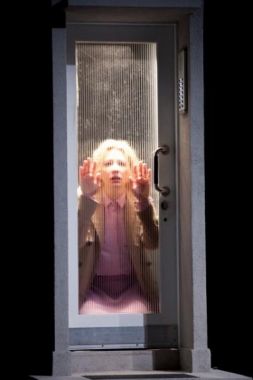
The Oscar-winning actress Cate Blanchett has accepted one of the biggest challenges of her career: playing Lotte in Botho Strauss's Mystery drama of seasons Big and Small, the most beautiful and important piece of contemporary German dramaturgical repertoire. Big and Small projects its roots in the German seminal Romantic tradition. The heroine's pilgrimage through the seasons of the soul has as stage background not less than the social totality, the new Cosmology and its runway universe, the Big Science and its "logicians", but moreover the dissolution of the individual self in the enduring social produced madness and alienation. After an extraordinary season 2011 at the Sydney Theater, the production finally arrives in Europe in March 2012. I have chosen three key scenes, but these fragments belong to the first English translation by Anne Cattaneo (Contemporary German Plays II, New York, Continuun, 2002), not the new one by Martin Crimp, specially commissioned for the staging. The great plasticity of the figures and the romantic imagery offers many possibilities to the translator. The dissolution process experienced by the schizoid Lotte already on her vacation in Morocco reaches its climax in "The Filthy Angel", when she finally finds herself naked with her already destroyed ego confronted with the great chess players's heartless logic of ice brink in the “time of great leisures”.
José Galisi Filho
Morocco
LOTTE,
middle thirties, alone. Noticeably dressed up, a tourist in the evening on the Mediterranean. Light pantsuit, very colorful blouse, hairpiece in a knot at her neck, large earrings, false eye¬lashes and fingernails. She sits at a table in the dining room. Behind her is a set of outsized Venetian blinds, not entirely closed, so that moonlight comes through them, along with the shadows of two men who are taking a walk outside on the
terrace.
LOTTE: Can you hear?
Two men are walking up and down outside. Forever.
Deep voices. Can you hear? Crazy
(
She rubs her ear. In a disguised voice she mimics a picked-up sentence)
"Real wonders were accomplished .. ."
Crazy.
What deep voices these guys have!
They're not from our Siesta Tour.
They come from somewhere else.
Lord have mercy, in the heat of the night.
That sounds good! Boy, oh boy .. .
They don't belong to us, those guys.
I've never heard
such .. . such . ..
har-mony!
It would be healthier not to listen.
But what can you do?
You just can't sleep
with these supervoices outside—
The first one says:
"Why not think everything through again
from the beginning, Floyd?"
Yep. Floyd. That's the other one.
Floyd says: "This isn't getting us
any further and further's
where we've got to get.
So I suggest
we think ahead regardless of the consequences,
not think it through again from the beginning."
Yep. Peace. Now they're quiet.
Walking up and down again.
Logicians, that's what they are . .. !
Morocco, crazy!
You'd have to have seen it.
At the beginning -we were a good tourist party.
We got along together. But in the meantime.
The infernal heat. Now it's sort of all against one
and one against all.
Did you hear?
The first one calls the other one Floyd
but Floyd doesn't call him anything.
This has been going on for hours, crazy.
Floyd never calls Non-Floyd by his name.
I'm just waiting around to finally find out
what Non-Floyd's called.
I'm just waiting around for Floyd
to finally let it slip out,
what Non-Floyd's called.
At least a little Ha— or
Bi— or To-—, Chr—, Ro—, Ri—, Jo-
Crazy.
Logicians.
I wish I had that kind of peace of mind.
(
She drinks a glass of mineral water)
The whole house full of wicked people.
There are two strangers outside
and there's solace in their voices.
As long as they keep walking
there's still hope
that they'll look in here later.
They'll notice: here in the dining room
there's still light, at least that much
presumably they'll notice.
Only when I start to hear them starting
to leave the terrace
then I'll know
they're going through the main entrance
up to their rooms,
not coming by here as expected,
where they would presumably, last but not least,
invite me to have a drink with them,
seeing that I'm not getting any younger,
sitting here like this.
Only when they're actually lying in their beds,
not till then will I be certain
that again today, the whole live-long day,
there's been nothing new for me, there's been nothing.
Eleven more days in Agadir.
Time passes.
All I've done so far is gain weight.
Everything is very simple: nothing's right.
Time passes, but not the way it should.
I feel, like when there's mail at home in the mailbox.
I see a big envelope.
I see the address, handwritten:
Number 8, Street of January 13, Saarbrücken 66. Crazy.
Who can be writing me there?
The book club announces its annual selections.
Oh. Well. I'm happy. Better than nothing.
Another close call, just missed having no mail.
There!
Can you hear? The first one . ..
A doctor's voice.
It's Non-Floyd who's speaking.
He's saying . . . just a sec! . . . sounds like . . .
He just said something like . . .
It's hard. Something like "the elements,"
"the elemental." Crazy.
I can't understand a thing with that
supervoice . . . that voice . . . music, music!
Just now he said: "warning ..."
You have to have heard it: "warning."
Fabulist!
Logicians, that's what they are.
And Germans!
Of the two of them Floyd presumably the guiding light.
This can be seen in that
Non-Floyd constantly calls Floyd
by his name,
but Floyd never utters the name of Non-Floyd, although
you'd
think he could let it slip out at least once, as I said before.
What were they just saying?
What did they mean?
It had to do with the one.
The one elemental.
After that it was "the elements" . . .
The elements, hm-hm-hm
(
She tries to find the word)
What did they mean?
So then ... so then ...
Someone crossed the Rubicon.
So-and-so crossed the Rubicon.
A name fell.
Didn't sound like all that much.
Small vocabulary. Tiny little word.
Such a little word, it doesn't resonate in the chest,
and without the chest Floyd makes it sound,
and Non-Floyd too,
like a little mouse shooing across a kettle drum.
Wait a minute! Floyd .. .
(
She smiles; fast, staccato)
"radiant with joy" . . .
(
Amused)
"by all means," "by all means."
Non-Floyd: "admitted," "frankly" . ..
(
Becoming faster and more intense)
Floyd: "Abuses are . . . centered in . . . drinking and a
craving for ..."
What? I don't understand . . .
Non-Floyd: "Greed . . . hustling, a fangs-bared
ego-..."
Floyd: "Unsatisfactory!"
Non-Floyd: "Greed . . . difference between those who
greedalone?
And those
(
Becoming slower)
in spite of greed . .. spiteofgreed."
The End. Greed.
Crazy. So fast!
The logicians are leading, I can tell you that.
Now first they're going to make their
two or three little rounds, first they're going to think
it over, what they just said in such a rush.
Nice voices.
Wonderful sound.
Like I said, smooth as fudge.
But what were they talking about just now, dearie?
God, what were they talking about. .. ?
What can I say?
About drinking.
About avarice.
Don't ask me.
I'm not the kind who recollects everything.
I'm not a remembering kind of person. I never was.
Did I just hear myself say "Greed"?
As long as they keep walking
it's possible after all
that they'll take a look in here,
have a drink,
and get into a conversation with me,
as long as they don't decide
to go down to the beach and then up through the main entrance.
In this infernal heat no one
can find the sleep of the just.
Only those who undertook something today,
who went on the excursion to Marrakesh
and only got back late in the evening,
they're sleeping now, sound as rats.
I didn't do.
Completely at odds, our group is.
I like to sit all day long in the lounge,
where there's always a cool breeze.
The women yell at the men,
one after the other they drop their masks,
the men yell at the women
in the middle of the desert.
I haven't done any extras.
None from the beginning.
I didn't even book any extras.
(
She drinks)
Greed, envy, disinterest,
avarice, and zeal—
these are the passions
that have afflicted our Siesta Tour the worst.
And drinking.
And—
you forget it every time, Floyd,
as soon as we start to talk about this
there's a logical step missing
at this point
and it is: the distance
between the well-to-do,
who can afford quite simply everything, and the
less well-to-do, who can afford, down the line,
only the most essential of the best the promoter's organization
has to offer, that is, no extras of any kind.
That's how they talk. Crazy. Just like that.
That's just about the way they talk.
Of course with a different touch mentally.
They talk about completely different problems.
I mean only, the way they talk is just about the same.
Such deep voices, Lord have mercy.
Everywhere there's confusion, for years
confusion and bad luck,
lies and running around—
like Paul in Saarbrücken—
a life of separation,
and then men like Floyd and Non-Floyd,
what friendship!
What logic!
What voices!
You learn so quickly . . .
Can you hear?
It's starting again.
Floyd: . . . sounds like . . .
"vale of tears" . . .
Nice. So nice!
(
Sings a little)
Vaaale-of-tears.
Crazy.
Non-Floyd:
(
Repeats quickly)
"The earth aches" or "quakes" . ..
"Man has lost his picture of mankind ..."
The earth aches or quakes.
"Hold on," says Floyd.
"We can't go on without thinking this through!"
(
Unsatisfied)
The earth aches or quakes.
Not much there. They're already quiet again.
Sounded like . ..
a man had lost a picture.
Or package?
Package or picture, I could be wrong.
Wasn't anything earthshaking.
A picture, oh, well.
Lost, yeah, yeah.
But that's
it!
That's
it!
He almost let it slip,
what Non-Floyd's called, almost!
Hold on, Floyd said, like that!
That's what he said: Hold on . . .
(
Tries to find the name from the rhythm)
hm-hm . . . hm-hm-hm . . .
Tip of my tongue! Ha—!
Her—! Raaal—! Bar—!
Or Carr—!?
It
must have slipped out of him.
Shit.
Eleven more days in Agadir.
(
Sings loudly)
Vaale-of-tears.
Two men, crazy.
Up and back, back and forth.
Not exactly light on their feet, I must say.
Men in full manhood,
on leather soles, in good shoes,
going their rounds and, listen: a distinct crunching
out there on the terrace,
sand, leather, and stone—
under a certain weight,
under the press of stature,
they're no sandal-wearers, inaudible,
no cloth-shoe strollers.
Probably light evening suits,
cream-colored the one and lilac the other,
with a maroon tie, and behind the knot
the collar is open a little,
for that throat, for that voice!
Inaudible, too, the slap of the trouser legs.
The one is jingling a lighter and change
in his jacket pocket:
Non-Floyd, I guess, while he thinks.
Floyd, the guiding light, doesn't need any jingling
to think. >
Oh, I wish I were Floyd
or Non-Floyd and were walking up and down
next to Floyd or Non-Floyd
out there tonight, step for step ...
No, no. I don't want anything.
Who do I think I am.
I'd just like to hear you speak, my blessed pair!
Oh, speak, my indivisible voices . . . !
One day in Marrakesh
should cost me seventy-one dollars
in additional pocket money.
On top of this, visits to the market,
that means purchases, without them why go to Marrakesh?
On top of this, countless mobs of beggars,
fruits, drinks, and lunch on the side.
On top of this, the heat,
and that I can't always take riding in a bus,
and there's constantly the fear,
will I be able to stand it today or is today a day I can't,
the constant cold sweat, worrying whether the bus will make
it to
a stop
before I get sick,
when anyway we're all
mortal enemies, one against all.
There!
Floyd . . . !
(
She jumps up; laughs happily, tries to understand)
What?—What?—What?
(
Moved by the voice, she advances a few steps—away from the direction in which she is listening)
Yes! . . . Yes! A fraid
A fraid fraid fraid
(
She speaks in high spirits)
Behold, man will
depart from this earth
and be done in all his works.
After him the earth will redden with
shame and fruitfulness.
The gardens and the fields will
enter into the empty cities;
the antelopes will browse in the rooms
and the wind will gently leaf through open books.
The earth will be unmanned and will bloom.
Freed from all its prophets, fettered hope
will be redeemed and will grow rich in the silence.
Freightless, the sea lulls itself,
the land wanders untrodden and the air plays in tall flowers. And it will be so for one thousand two hundred and sixty days. ..
(
To herself again)
One thousand two hundred and sixty days . . .
what does that mean? How did I arrive at
one thousand two hundred and sixty days?
That adds up to about four years.
Four years, not quite. Four years of what?
(
She listens)
The men have stopped!
The men aren't walking any more!
Merciful heaven, what have I said?
They've stopped—!
I'm listening: they're standing, they're swallowing!
They're listening! They're hearing me . . .
Dear God, make them go on walking . . .
They're hearing me!
(
She holds her mouth closed)
Non-Floyd: "It seemed to me
that someone cried out inside."
Floyd: "I thought that someone
cried out,.too. Though at the moment no one is shouting.
Either the need has passed—"
Non-Floyd: "or the joy—"
Floyd: "or there will be another cry" . . .
They are quiet. They look at the tips of their shoes.
They raise their heads, inaudible, they shake their heads.
Crazy.
They're walking! Almighty God, they're walking again!
(
In the course of the final sentences, piece by piece she re¬moves the hairpiece, the earrings, the eyelashes, etc., and puts them all on the table in front of her)
I suppose—
I suppose I did get a little too loud.
How stupid of me.
How stupid.
It isn't easy for me
to spend my vacation
without—
without even a chat,
sometimes days without a single hello.
So that evenings
one little word
can easily slip out and I don't even notice it.
I'm talking up a storm and I'm positive that
I'm only thinking. What can you do?
You just have to get it straight once and for all
and then it's all right.
(
She falls silent and listens)
Nice voices.
Can you hear?
Forever.
Better now than then.
(
She smiles)
Crazy.
(
Darkness)
Wrong Number
Empty stage. LOTTE on a chair. Very pale face, smeared mascara under her eyes. A gigantic book lies open on the floor in front of her.
LOTTE: Where now?
No answer.
Sitting here like this—
I should have left long ago.
I can't forget:
the spirit moves me to go sitting here like this.
Floyd has left
and Non-Floyd has left.
Edward has left
and Inge has left.
Soren and the Turk have left.
And Wilhelm, Meggy, Pechstein,
and Karin.
At the end Paul left, too.
North south
east west
far wide
northeast
north northeast
a distance unthought through.
One degree one minute
no one's there
then two degrees one minute
passed away
then heaven or hell
ocean or book—
I wouldn't know
where else they could be hiding.
The wind rose
and the windless rose, too:
there's nothing more.
That is the whole round of the earth.
Or oval.
Paul didn't stay.
The room didn't stay.
Bernard and Sister Annegret
didn't stay
De Soto, Father, and Clown Grock
didn't stay. Here in the book
even the guests' script didn't stay.
The script didn't stay.
I'm sitting completely, utterly in the open!
But I can't become
as white as the book.
Not me!
When the blank pages start to come at us again
it's in God's hands, my misbeloved.
Where now?
Each step could be the wrong one.
Where next in this everywhere?
Utterly free, utterly free.
Completely.
Given: I go to look for Paul.
Given: I knew where to begin . ..
No. I won't be able to get up if I think like this.
Thinking like this, no man alive could
get to his feet.
Careful, misbeloved, careful!
Thought is thought.
Something like that can't be blacked out
like a forbidden line in a book.
As long as it's me who's thinking,
it can only be wrong.
Or in Paul's words:
Sit here quietly,
never talk out loud.
We'll all be back soon.
OK, OK.
Then I'll say to everything that I'm thinking,
No!
Once before, when I just
couldn't forget things,
Emily gave me moral support.
Emily left Carl.
Carl left Dorothy.
Dorothy left John.
And at the end Paul left, too.
It's you I love.
It's you I love!
Could he hear me?
It depends.
In the West perhaps.
In the West it's,
from where I'm standing,
not more than about five thousand miles
to the end of the West,
where America ends and the East begins.
In the West a Paul could hear me,
could! However faintly, however barely.
Perhaps he'd notice a wisple-pisple
and think it was his inner voice.
His own little squeaky voice,
which he never listens to, anyway.
Yes, that's what they say.
What it's really like,
no one knows.
Of course no one will return.
It's a figure of speech.
All this time.
Not one.
How could they?
Going is going and going.
Things are dissolving.
We know that from science.
Or, if you will, the guest book.
Book losing script!
Or the mouth.
Mouth losing rouge.
Things are dissolving.
The soil is losing its seed.
Death is losing its dead.
Things that belong together
are sick of each other and fly apart.
just like the cosmos in general.
It's exploding slowly endlessly outward.
We don't fall, as often dreamed,
we fly upward, away from each other.
Seen like this, things now for the first time
take on their actual weight.
Cosmos and supercosmos, upward,
and away!
Why take a stand against the turn of events?
Are you listening? Chair!
Wake up! Lazy old thing!
Just you and me, we're still here sitting tight.
You're on the ground, I'm on you.
The turn of events has just rolled over us, you say?
That's no reason at all to get yourself go, you!
A person has to always want something!
The clock has to always strike something!
(
She stands up)
Ding dong Gloria.
Oh, the beautiful sky, unique each time!
And clouds, wet bellies, air shows!
Ding dong Gloria.
Today heaven lies round us like a cave,
a womb, a garden,
and soon we, the little earth, will come into the world.
Ding dong Gloria.
Doesn't Lotte know
what Lotte's saying?
(
To the chair)
No, Gracious Lord, oh ...
Your bride, the misbeloved, doesn't know any more.
You call yourself my bride?
I say it only out of courtesy,
Almighty Father.
I didn't know that you happened to be so close by.
(
Suddenly, as if she were in her apartment)
Oh, God, my house is a chaos . ..
No, please, leave me alone!
I'm not the one you think I am.
I was just babbling away.
What of it? And I didn't mean anything by it.
I swear it, nothing to it and nothing behind it.
But please don't come any closer to me,
Heavenly Father, I beg you.
I cannot be your cup or your chalice
or any other vessel.
Then you would will me to break
and I should burst at the seams.
I cannot endure it with you, too!
I am not strong enough for that. ..
Oh, not this yellow!
I am terrified of yellow!
Not this yellow light!
Take Josephine or Meggy,
she can read palms,
but not me!
I am unworthy!
Lord, is this to be my punishment?
Just because I talked out loud to myself a little?
What am I supposed to do?
Why did you send all the others away?
Why?
What?! ... I don't get it.
Leave me alone! Get away! It's a mistake! Wrong number!
No! . .. Help, help!
(
She lifts up the book)
The book, the book . ..
The emptier it is, the heavier it is.
Don't touch me! Get out!
(
She hoists the book above her head)
Don't touch me!
(
She strikes the chair with the book, smashing the chair and, doing so, falls to the ground. She stands the book upright, so that it screens her from the wreckage of the chair. She squats with her back to the binding of the open book)
I don't think
I could have shaken Him off.
He can get in wherever He wants to.
He's probably already in, where He wanted to get.
(
She scratches her back, looks at a bloodstained hand) Blood! . . . What's bleeding on my back?
There was nothing on my back . . .
(
She tries to look at her back, turns around, squatting in front of the book. There is blood running down from a small slit on the right page. She reads aloud, as if trying to make out writing that has just come into being)
Faith Hope Love
Faithhopelove: No!
(
She slams the book shut. Blood continues to run from the front edge. She rips scraps from her clothing, tries to clean the book) He makes me feel so little . . . !
I can see it coming. He'll get me to where I'm nothing.
Oh, why wasn't I watching out! To send everyone away and then start in on me . . . To send everyone away
and then slowly start His witch work on me . ..
(
She cleans and embraces the book)
Oh, no .. . Oh, no.
(
Darkness)
The Filthy Angel
Lotte
Man in a secondhand army jacket
A bus stop, a full trash container. A young MAN in a secondhand army jacket is waiting. In the background LOTTE walks past several times: short light hair, very pale face, again in the old, still extremely bleached-out suit, sneakers on her feet, a large shopping bag on one arm. She walks with hurried tripping steps, stops sometimes abruptly, looks at her feet as if she didn't trust them, sets them parallel to one another. It looks as though the rhythm of her own steps disturbs her. Finally she approaches the young MAN from the rear.
LOTTE: Be not afraid!
I only want to stand next to you for a moment.
(
She places herself next to him)
There.
MAN: Well, now what?
LOTTE: Better. I feel better.
Just a little bit longer.
(
She suddenly begins breathing, opening her mouth wide each
time, swallowing air)
MAN: What are you doing?
What's the matter with your mouth?
LOTTE: Don't know.
MAN: Can't you get enough air? LOTTE: Yes, yes ...
It's over now.
I've been sneaking around behind you the whole time.
MAN: I noticed.
Don't you have anything better to do?
LOTTE: I'm happy to be here. MAN: Huh! Well, I'm drinking Lowenbrau:'cause my computer graduated from high school today. LOTTE: Ah, a joke, a joke!
Men always have to make jokes, right?
I bet you're one of those people
who puts on your seat belt when you see a movie
at the drive-in.
That's an American joke.
MAN: I wouldn't want to run into you at the breakfast table.
With
that face . . .
LOTTE: YOU get used to it, young man.
MAN: Probably. Bad enough.
(
Pause)
LOTTE: God is simple. He is true in word and deed.
He doesn't change and He deceives no one. MAN: Get out of here. LOTTE: Don't want to.
MAN: Jehovah's Witness, huh?
LOTTE: (
Shakes her head) I'd like to stay, up until
you get on the bus.
MAN: What are you? What kind of person?
Not old, not young.
Chalk-white from head to toe.
In moonlight, couldn't even see you,
white as you are now.
Lily white or hoar-white?
LOTTE: Can't you see what I am?
Didn't I part my hair straight?
Don't you like me at all?
MAN: What else, huh?
LOTTE: (
Whispers in his ear) I am one of the righteous ...
MAN: Lily white or hoar-white?
LOTTE: I am one of the righteous.
MAN: Jehovah's Witness, oh, fuck, shit.
LOTTE: NO. A righteous person is—
Look: in the whole word there are only thirty-six righteous
men.
Only thirty-six in the whole world! The number is fixed.
It was put in writing by the ancient Jews. Each generation
receives from God thirty-six righteous men, who hold the
world together but who live in hiding.
No one knows them, everyone knows that they exist.
It could be your neighbor!
Thirty-six righteous men, whom no one knows,
and.the world depends on them.
MAN: And of them, you're one.
LOTTE: Yes. Coincidence. I can't help it. Coincidence.
MAN: And what does one do as one of the righteous?
LOTTE: Goeth one's way. Get to know people.
Help, wherever you can. Just help always.
Make life difficult for the Antichrist.
MAN: Does that take up your whole day or—?
LOTTE: Whole day, yes.
MAN: And job-wise nothing else?
LOTTE: On the job, too. Where I work, too. Everywhere.
I used to be a physical therapist, a graphic artist, and soon
an interpreter. I'm going to be. And yourself?
MAN: My name is Bob Fechter
and I work in broadcasting.
LOTTE: In broadcasting ...
What exactly in broadcasting?
MAN: Computer programmer.
LOTTE: What are the fine points of that? Tell me!
MAN: Well, as you can perhaps imagine, such a big operation
has got to have x-million facts in the data bank
at all times!
LOTTE: Yes.
MAN: Well.
(
Pause)
LOTTE: Protestant or Catholic?
MAN: Nothing.
LOTTE: A-the-ist?
MAN: Not even.
LOTTE : Not even an .. . atheist— (
Suddenly in a rage)
Who on earth, who do you think is up there sending the light shimmering down on us?! Man, Bob! Watch out, watch out.. . You don't know what's going on .. .
MAN: YOU sure do have a lot to say.
(
Again LOTTE
is seized with shortness of breath) Stop that!
Stop your mouth from opening and closing. Do you have some kind of illness? Are you going to sweat it out here next to me? LOTTE: It's better already. It just happens to me. It's not a cough.
You don't know what's going on . . .
MAN: HOW long have you had this?
LOTTE: It just started here.
MAN: YOU are not healthy.
LOTTE: Everything's still so new to me . . .
MAN: Just don't die on me here.
LOTTE: No. I won't die.
(
He takes a package of lozenges from his jacket pocket. He
holds it out to her)
What is that?
MAN: Multivitamins.
LOTTE: That doesn't do anything, that stuff.
MAN: If Farrah takes them, they can't be too bad.
LOTTE: Does she take them?
MAN: Yes. Everyone knows that.
LOTTE: Only on TV.
MAN: I'm sure she takes them otherwise, too. It's not too bad, this stuff.
(LOTTE
walks slowly to the trash container which it fastened
to the bus-stop sign)
MAN: Where are you going?
LOTTE: I just want to see something back there.
Turn around!
(
She rummages in the garbage, collects paper in h$r bag) MAN: (TO himself) A woman. ... Not old, not young. A woman . . . this too, hm? If one had a question at home, say, she would answer. What do you mean "question"? Well. That's true, too.
With two people you laugh better watching TV than with only one. , (In doubt, he raises and lowers his shoulders) She knows how to play chess ... But that's exactly what you can do better at the club. She doesn't know how to play chess ... Handicap.
(
He glances at
LOTTE: What are you doing over there?!
You little piglet.. . ! '
Phooey! .. . Ugh!
Get your hands out of that shit! Ugh!
LOTTE: Coming, coming ...
Turn around! I'm coming . . .
MAN: Ugh! . .. Nasty! Nasty!
LOTTE: Don't say anything. Quiet. I'm coming.
(
She comes back and again stands next to him)
MAN: HOW can you let yourself go like this. Phooey!
LOTTE: I'm not.
MAN: I saw you. Rooting around in other people's shit.
LOTTE: I was only looking for the papers.
If there was anything in them about Paul.
Just papers. Dry stuff .. .
MAN: Nowadays here nobody has to eat
anyone else's shit.
LOTTE: NO.
MAN: YOU could look halfway decent.
You have an occupation, you could help.
There's no reason to let yourself go.
LOTTE: I'm not. I was just taking a quick look at what was
published.
MAN: Only the mentally ill put their hands in there, vagrants put
their hands in there. Greedy, greedy like hyenas .. .
LOTTE: (
Quietly) I am one of the righteous . . .God has come back.
MAN: YOU are a woman. Not old, not young.
You could look halfway decent.
Find a group of friends you like.
Start to work on your problems together.
You could look like a woman everyone likes.
LOTTE: Me? Well. I don't know.
Make a vision for me.
MAN: Maybe tomorrow, maybe only day after tomorrow—
what are you going to do when the leisure culture arrives?
The leisure culture is coming as sure as an amen in church.
LOTTE: Right. Go on!
MAN: The people who don't have a good grip
on themselves, who don't know how to keep themselves busy,
in other words, who let themselves go—!
LOTTE: I'm not, I'm not!
MAN: For example: I belong to a chess club.
Twice a week. Always the same respectable
faces. First of all: the quiet. That alone is enough
to put you at ease. Then the games with other clubs.
The enjoyable trips—
(
He falls silent)
LOTTE: Lovely. Go on.
MAN: What are you going to do when the bus comes and I have to get in?
LOTTE: I won't go back in the trash, Bob!
MAN: But what are you going to do?
LOTTE: Well. What to do ... ?
What to do, what to do,
when the music's over . . .
MAN: Do you know how to play chess?
LOTTE: NO.
MAN: DO you want to learn?
(
She looks at him, shakes her head slowly)
LOTTE: NO ... No.
(
Pause)
MAN: The players take their places.
One offers one's hand but one doesn't shake . ..
Among themselves the men call each other Korchnoi and
Karpov, Polugaevsky and Portisch. Or Spassky and Fischer. Or—
(
Darkness)
Images - above: Cate Blanchett; below: Anita Hegh; Robert Menzies and Cate Blanchett & Chris Ryan and Cate Blanchett in Sydney Theatre Company’s Gross und Klein (Big and Small). Photographer: Lisa Tomasetti.
Some reviews on the Sidney Season:
“Strauss’s play is an obscure one and at three hours, it’s not your typical silly season theatre fare. But Blanchett gives the performance of her career. Smoking and nervously pulling at her underwear, she is goofy and wildly enthusiastic as the young abandoned wife.” (Sun Herald)
“Directed by Benedict Andrews and designed by Johannes Schutz, it is now presented in the context of a post-GFC Europe that is amid yet another crisis. But the great artist who guides us here through Lotte’s odyssey is Cate Blanchett. This is a stunningly expressive performance, supported by an excellent cast. Her extraordinary vocal and physical skills as an actor have never been in doubt, but here she is magnificent. Her Lotte dances frenetically across this vast blackness. She falls to the ground and then springs up again. Vernacular humour and farcical comedy are interspersed with gloriously ironic visions of the transcendent and sudden moments of anguish. Blanchett plays this abject, increasingly deranged but ultimately innocent character with a mixture of vulnerability and luminosity that is heartbreaking.” (The Australian)
“With Blanchett’s exquisite comic timing, director Benedict Andrews’ brilliant vision and a strong ensemble cast, this is a ripper.” (The Daily Telegraph)
“In Benedict Andrews' jaw-dropping production by the Sydney Theatre Company, Strauss's brave experiment in anti-narrative succeeds powerfully in one of the greatest functions of art: to make us look afresh at ourselves and our surroundings…When played by an actor of the extraordinary emotional agility and range of Cate Blanchett, the role of Lotte dazzles as a star vehicle, reverberates in the ear as a prose poem, and touches us deeply as a meditation on the squirming position of a single human being.” (Time Out Sydney Online)
“Against the odds and the run of play, Lotte's predicament is very funny - thanks to the extraordinary performance of the extraordinary Blanchett. And the outcome is scorchingly, painfully sad as dreams and possibilities crumble; are seen to be ridiculous, unattainable or simply never there in the first place.” (Stagenoise.com)
The great book of the play by the Sidney Theatre Company 2011, a fantastic didactic and research work for English speakers:
A Journey across contemporay Germany by Botho Strauss:
http://www.sydneytheatre.com.au/downloads/Gross%20und%20Klein%20_Big%20and%20Small_%20Pre-production%20resources%20STC%20ED%202011.pdf
Sydney Theatre Company
Big and Small
A Journey across contemporary Germany
by Botho Strauss
English version by Martin Crimp
Director: Benedict Andrews
Set: Johannes Schütz
Costumes: Alice Babidge
Lights: Nick Schlieper
Sound: Max Lyandvert
In.
Big and Little.
Contemporary German plays, Volume 2. Edited by Margaret Herzfeld-Sander. Included in this anthology are also: --
Farmyard by Franz Xaver Kroetz--
Offending the Audience by Peter Handke--
Eve of Retirement by Thomas Bernhard--
Big and Little by Botho Strauss.New York , Continuum, 2002.